glass mirror
As long as it stays small, is securely mounted, and no one bumps into it. Glass is affordable and durable above the sink.
Business customers
 Gyms & ClubsGyms, Dance & Yoga, Clubs
 ArchitectureBuildings and Projects
Technology and Comparison
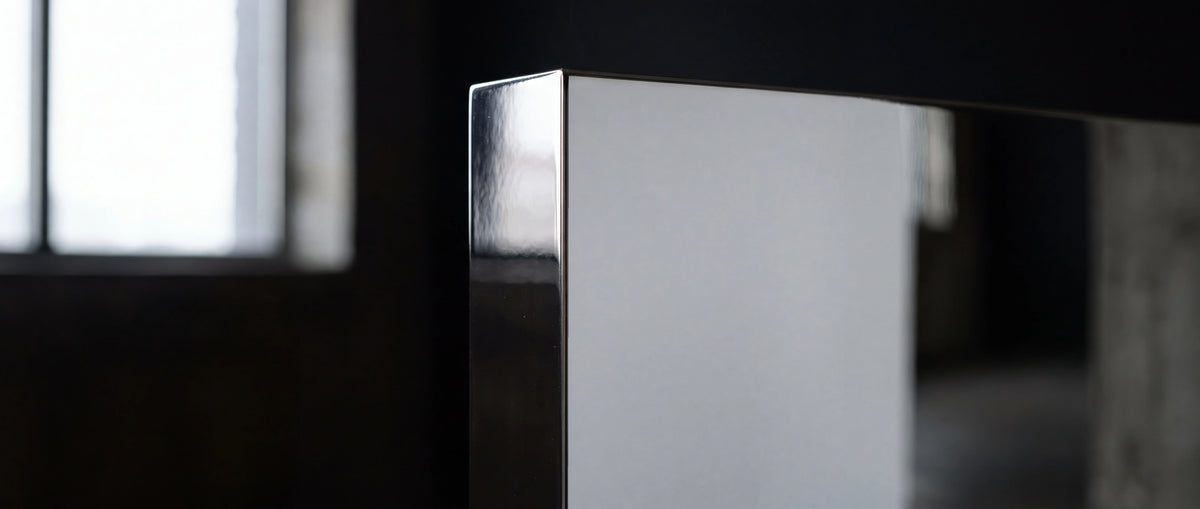
A foil mirror is a mirror without glass. A thin, reflective foil is stretched over a frame until it is as flat as a pane of glass. It weighs about 2 kg/m², does not shatter, and reflects only one image instead of two.
Structure
A total of 0.04 mm of film, stretched over a self-supporting aluminum profile. Tap on a layer.
The film is stretched onto special machines using a patented process. It is only through this process that the film becomes perfectly flat and mirror-like. That is why every elamirror® product comes pre-stretched and cannot be cut to size.
Physics
In a glass mirror, the reflective coating is located behind the glass. Light must first enter the mirror, where it is refracted, reflected at the back, and refracted again on its way out. Some of the light is already reflected back by the glass surface. Two reflections, slightly offset: the double image.
With a film mirror, there is no glass in front of the mirror coating. One path, one image. And everyone looks into a large mirror at an angle: in the hallway as they walk by, in the studio from the bench.
Physical reference values for float glass with a refractive index of 1.52 and a 45° viewing angle. These values apply to any rear-coated glass mirror.
Comparison
Five ways to build a mirror. Green indicates where one method is clearly superior.
| Property | elamirror® | Mirror glass | Safety glass | Acrylic | Adhesive film |
|---|---|---|---|---|---|
| Weight | about 2 kg/m² | about 15 kg/m² | about 20 kg/m² | about 3.5 kg/m² | It weighs almost nothing; the wall supports it |
| Fracture | does not splinter | breaks into pieces | breaks, holds together | shatterproof | cannot break |
| Reflection | an image, no offset | Double image through the window | Double image through the window | wavy over a large area | shows every bump |
| Crooked Wall | The frame determines the plane | even 3 mm can cause distortion | even 3 mm can cause distortion | rises on its own | follow the wall |
| Assembly | one person | two people, suction cup | two people, suction cup | lightweight, lots of adhesive dots | Sticking without bubbles is difficult |
| Large area | up to 3 m in one piece | possible, very difficult | possible, very difficult | varies with size | Paths with Jumps |
| Scratch | scratch-resistant top layer | very sturdy | very sturdy | very sensitive | sensitive |
| Cleaning | Glass cleaner, no abrasive | can handle anything | can handle anything | scratches when cleaning | only very carefully |
The comparative values are standard market guidelines: 6 mm mirror glass, 8 mm laminated safety glass, 3 mm acrylic, and self-adhesive mirror film applied to plaster.
Mirror film on the wall
Self-adhesive mirror film is applied directly to the wall. And hardly any plaster surface is truly flat over a width of two meters. Every dent, every putty line, every grain of sand shows through, turning the reflection into a distorting mirror.
With a foil mirror, this same idea is taken to its logical conclusion: The foil is not mounted on the wall, but on a frame. The frame defines the plane, not the plaster behind it.
Adhesive film has its place—on furniture fronts and smooth surfaces. It’s rarely enough for a wall mirror in which you can see your whole reflection.
Top view from above; you're standing below
Which Mirror for What
As long as it stays small, is securely mounted, and no one bumps into it. Glass is affordable and durable above the sink.
For small surfaces, children's toys, and craft projects. The image becomes wavy when used on a wall-sized surface.
For cabinet fronts and decorations on smooth surfaces. When used as a wall mirror, it reveals every dent in the plaster.
For large areas, children's rooms, home gyms, studios, rental apartments, and ceilings. Anywhere glass is too heavy or too dangerous.
Find a mirror with a reflective filmQuick Question
A mirror without glass. A thin, reflective film is stretched over a frame until it is as flat as a pane of glass. The result weighs about 2 kg/m² and does not shatter.
Yes. Because there is no pane of glass in front of the reflective coating, only a single image is formed instead of a slightly offset double image. This requires that the film be evenly stretched.
It never shatters. In the event of a normal impact, nothing happens; if subjected to brute force, the film may tear. However, no shards are produced.
Adhesive film lies directly on the wall and reveals every unevenness, causing the image to appear wavy. With a film mirror, the film is stretched over a frame; the frame determines the plane, not the plaster.
Acrylic is lightweight and shatter-resistant, but it warps on large surfaces and scratches easily. Acrylic works well for small surfaces, but not so much for mirrored walls.